Home » Heritage & Home » War of the Worlds Broadcast: What Really Happened in 1938
War of the Worlds Broadcast: What Really Happened in 1938
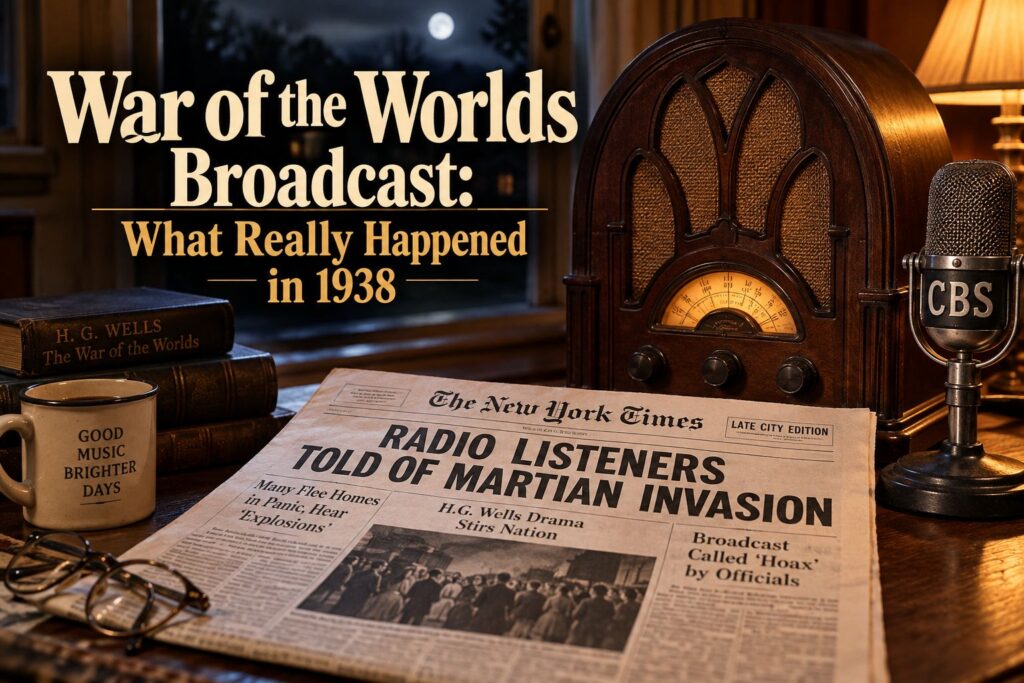
The War of the Worlds Broadcast of October 30, 1938, has become one of the most famous nights in American radio history. According to the story many of us grew up hearing, Orson Welles went on the air, announced a Martian invasion, and sent terrified Americans running into the streets.
It’s a great story.
There’s just one problem.
That’s not quite what happened.
Some people really were frightened that night. Police stations and newspapers received frantic telephone calls. A few listeners apparently fled their homes. Yet the nationwide panic that became part of American folklore was far more complicated—and considerably smaller—than generations of retellings would have us believe.
Oddly enough, I know firsthand how convincing the broadcast could sound.
I Thought the Martians Were Really Here
Sometime in 1969, I had recently moved out of my parents’ home and was living by myself. One night, I fell asleep and later woke up to a radio broadcast already in progress.
I hadn’t heard the beginning.
What I heard sounded real.
There were urgent reports. Something terrible appeared to be happening. And because I’d awakened in the middle of it, I had none of the context that would have told me I was listening to a rebroadcast of Orson Welles’ The War of the Worlds.
So I did about the only thing that seemed reasonable at the time.
I just lay there and sweated.
Eventually, of course, I learned that Martians had not invaded Southfied, Michigan—or anywhere else.
Still, I’ve never forgotten what it felt like.
And my experience happened more than 30 years after the original broadcast. Imagine turning on your radio on an October night in 1938, hearing what sounded like live news reports, and having no television, internet, or smartphone nearby to tell you what was really going on.
That brings us to the question at the heart of this story:
How many Americans actually believed Orson Welles—and how much of the Great War of the Worlds panic was created after the broadcast was already over?
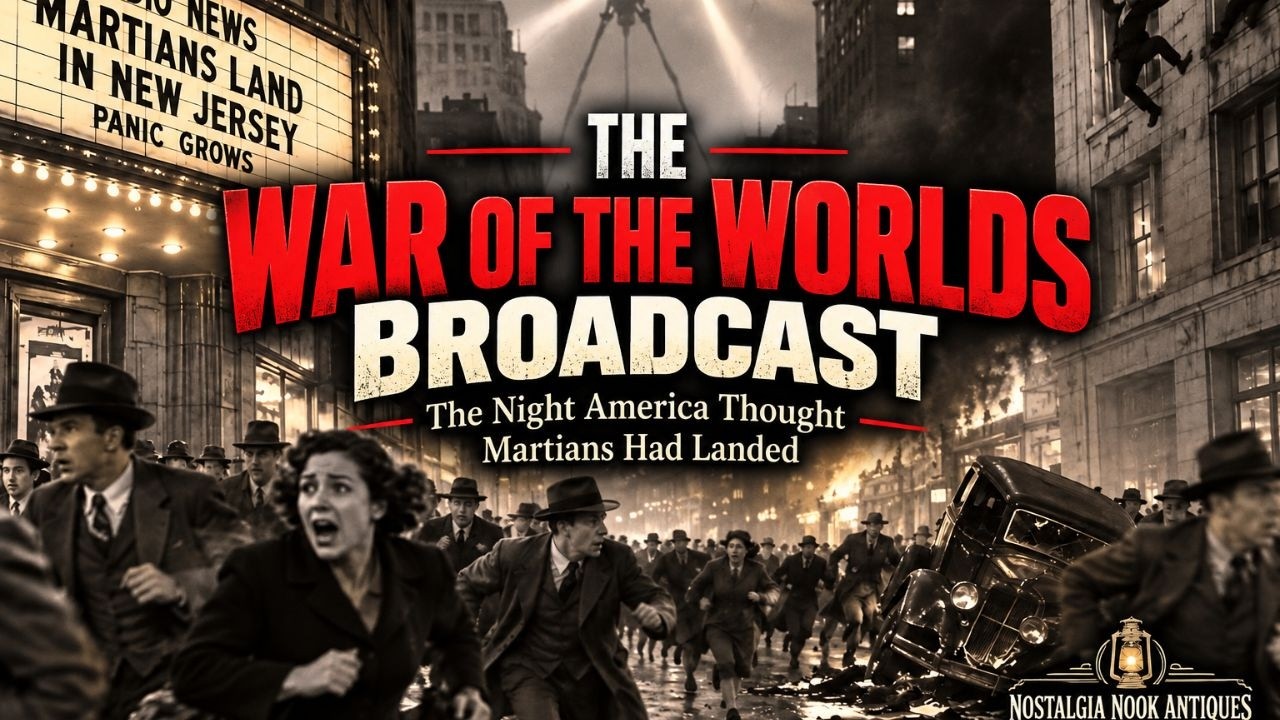
Hear the Original War of the Worlds Broadcast
Want to hear what Americans heard on October 30, 1938?
Listen to the original Mercury Theatre on the Air production of The War of the Worlds right here, just as listeners heard it on October 30, 1938. Then come back and discover why the famous story of nationwide panic isn’t quite what generations of Americans have been told.
Hear the Original 1938 Broadcast
Mercury Theatre on the Air
⭐ Featured Broadcast: The War of the Worlds (1938)
Original Air Date: October 30, 1938
Run Time: 51:22
On October 30, 1938, Orson Welles and the Mercury Theatre presented their famous radio adaptation of H. G. Wells’ The War of the Worlds.
Listen to the surviving original broadcast, then continue our investigation into what frightened listeners actually experienced—and how the legend of nationwide panic grew afterward.
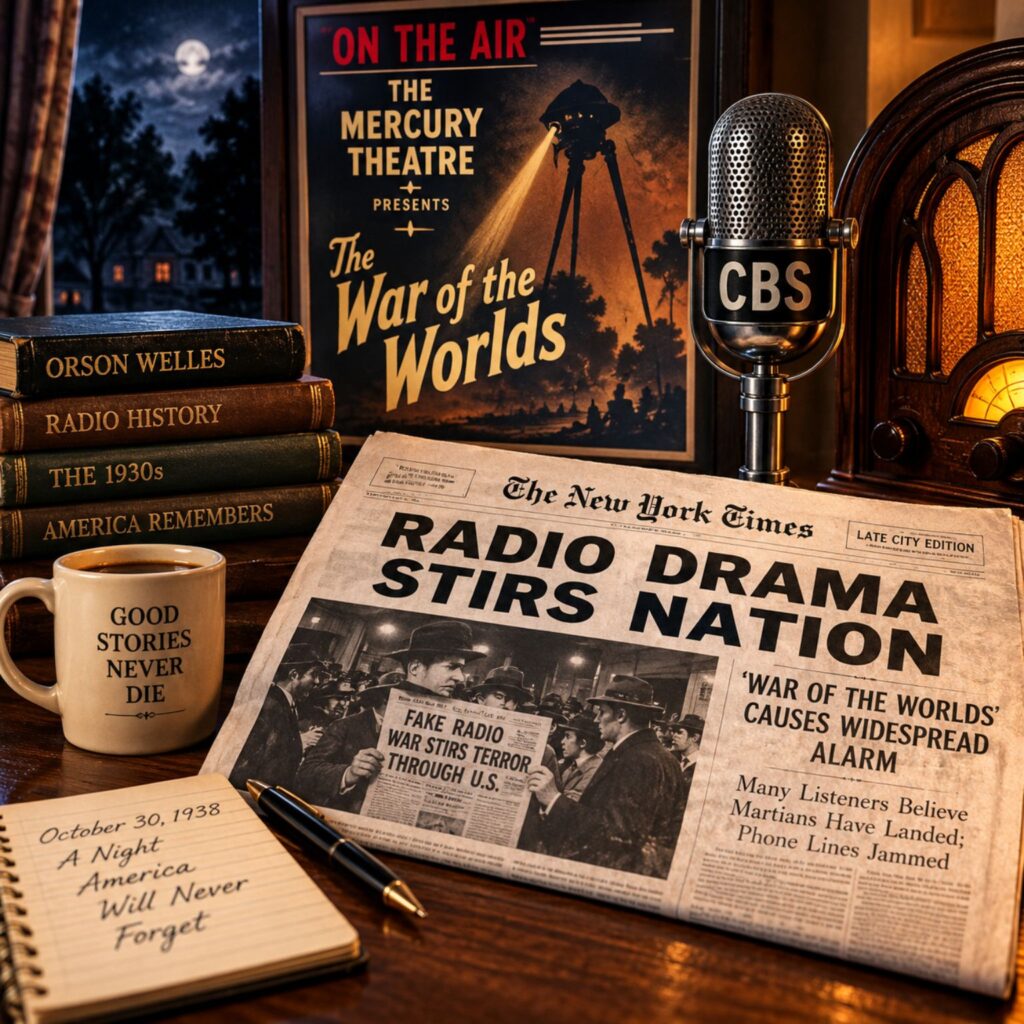
The War of the Worlds Broadcast began at 8:00 p.m. on Sunday, October 30, 1938. On CBS, The Mercury Theatre on the Air introduced its latest radio drama: an adaptation of H. G. Wells’ 1898 science-fiction novel The War of the Worlds.
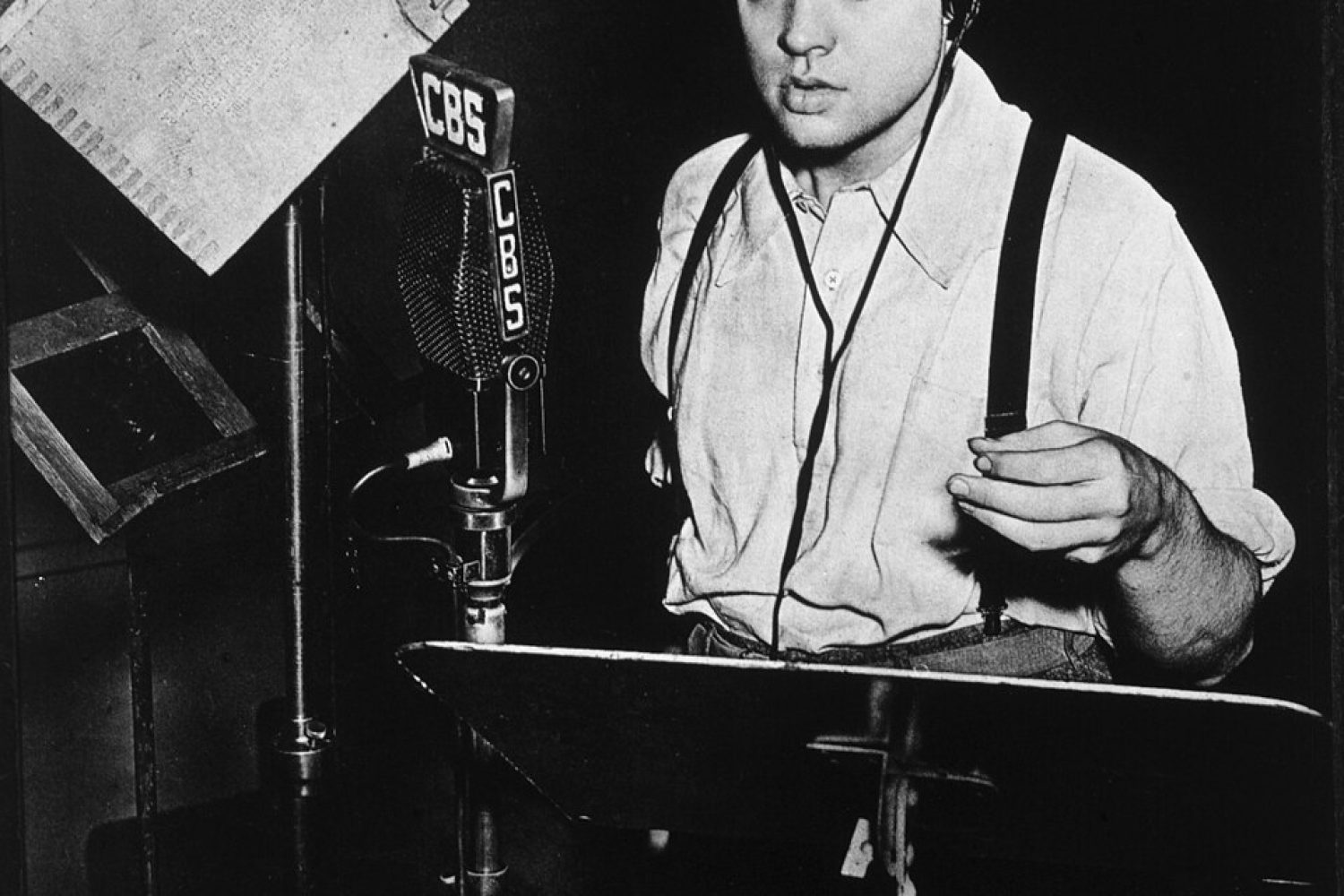
At the microphone was 23-year-old Orson Welles.
The program didn’t hide what it was. Welles opened by identifying the story, and CBS announced The Mercury Theatre on the Air. Anyone listening from the beginning had been given an important clue: this was a radio play.
Not everyone, though, was there for the beginning.
Across the dial, many Americans were listening to the hugely popular Chase and Sanborn Hour on NBC, starring Edgar Bergen and his wooden wisecracker, Charlie McCarthy. Some listeners apparently changed stations after that program’s opening segment.
By then, Welles’ drama had begun to sound very different.
From a Novel to Breaking News
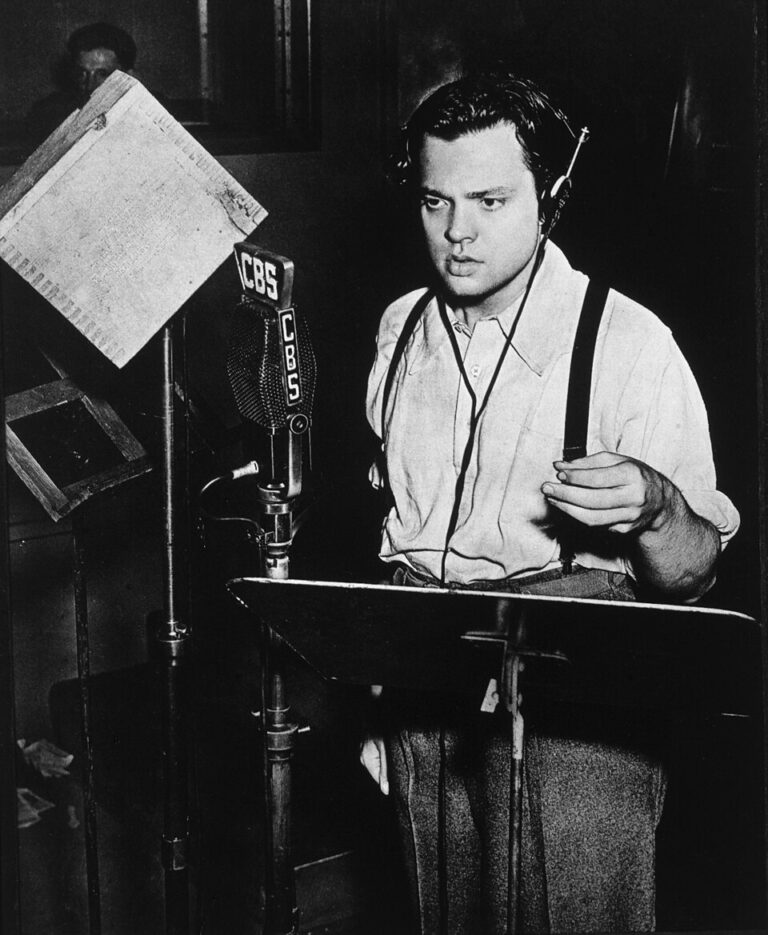
Orson Welles at a CBS microphone in 1938, the year of the famous War of the Worlds broadcast. Public-domain photograph.
Writer Howard Koch and the Mercury Theatre team had moved H. G. Wells’ story from Victorian England to contemporary America. Instead of simply having actors narrate an alien invasion, they presented much of it in the familiar language of live radio.
First came music from a hotel ballroom.
Then an announcer interrupted.
Astronomers had observed strange explosions on Mars.
The music returned. Before long, another bulletin arrived. Something had fallen from the sky near Grovers Mill, New Jersey.
Soon a reporter appeared to be broadcasting directly from the scene.
Listeners heard descriptions of a strange metal cylinder, crowds gathering around it and something moving inside. What had begun as an ordinary evening of radio entertainment was rapidly becoming an apparent catastrophe.
Of course, there were no Martians in Grovers Mill.
There wasn’t even a CBS reporter standing in that New Jersey field.
It wasn’t merely the story that frightened some listeners.
It was the way radio told it.
Nostalgia Nook Antiques Note: But if you had just turned on the radio, how were you supposed to know that? That question helps explain what happened next…
Why the War of the Worlds Broadcast Sounded So Real
The War of the Worlds Broadcast of October 30, 1938, has become one of the most famous nights in American radio history. According to the story many of us grew up hearing, Orson Welles went on the air, announced a Martian invasion, and sent terrified Americans running into the streets.
It’s a great story.
There’s just one problem.
That’s not quite what happened.
Some people really were frightened that night. Police stations and newspapers received frantic telephone calls. A few listeners apparently fled their homes. Yet the nationwide panic that became part of American folklore was far more complicated—and considerably smaller—than generations of retellings would have us believe.
Oddly enough, I know firsthand how convincing the broadcast could sound.
Why the War of the Worlds Broadcast Sounded So Real
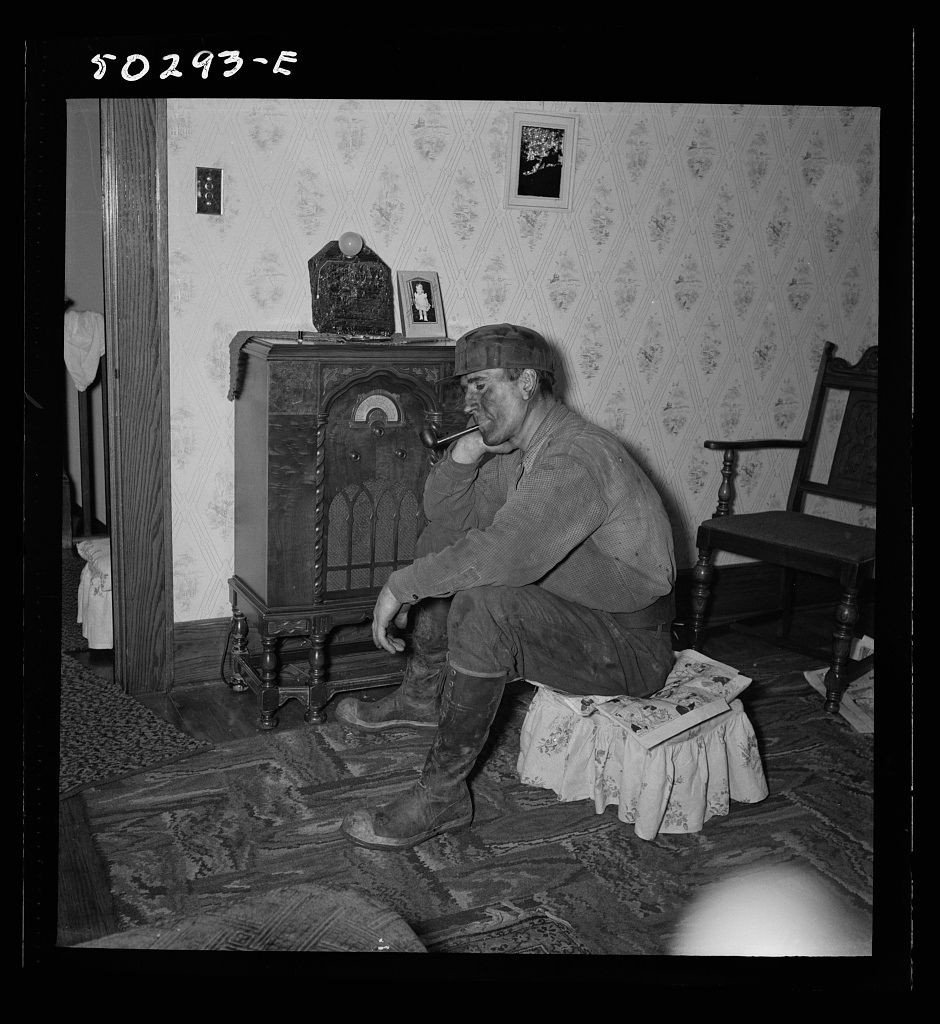
A radio listener in Westover, West Virginia, in 1938—the same year as Orson Welles’ famous War of the Worlds broadcast. Photo: Marion Post Wolcott, FSA/Library of Congress. Public domain.
Americans Already Knew That Sound
Only weeks earlier, Americans had listened as ordinary radio programs were interrupted by genuine news bulletins about the Munich crisis in Europe.
Those reports concerned Adolf Hitler, British Prime Minister Neville Chamberlain, and the growing fear that Europe might be heading toward another war.
So when music suddenly stopped for an important announcement, listeners already knew what that interruption could mean.
It meant news.
And sometimes, it meant bad news.
That familiarity gave the fictional bulletins in The War of the Worlds an extra layer of credibility. Radio had become one of America’s fastest ways to learn about events beyond the front porch, and listeners were accustomed to hearing important developments announced through the speaker in their living rooms.
The voices helped sell the illusion, too.
Listeners heard astronomers, professors, reporters, military personnel, and government officials. They heard recognizable American place names. They heard reporters who seemed uncertain about what they were witnessing.
Nothing required a picture.
Radio supplied the voices. The listener’s imagination supplied everything else.
The Clock Helped Sell the Illusion
There was another trick working in the broadcast’s favor: time moved strangely fast.
The fictional invasion unfolded at an impossible pace. Events that should have taken hours were compressed into minutes. Yet because the program kept jumping from music to bulletins, eyewitness reports, and official announcements, listeners could feel as though they were following a rapidly developing emergency.
For anyone who had missed the opening identification, the illusion could be especially convincing.
The broadcast had begun by clearly identifying The War of the Worlds as a Mercury Theatre production. Still, a listener arriving late might hear only the increasingly frantic reports.
By the time the program again made its fictional nature unmistakable, the Martians had already crossed a remarkable amount of territory.
Of course, most Americans weren’t fooled.
Some were.
And that difference is important, because the story we’re investigating isn’t really about whether anyone believed the broadcast.
We know some people did.
The bigger question is how many.
Nostalgia Nook Note: Radio didn’t need pictures to make the invasion believable. Sometimes, what listeners imagined was more frightening than anything a camera could have shown.
What Happened in Grovers Mill, New Jersey?
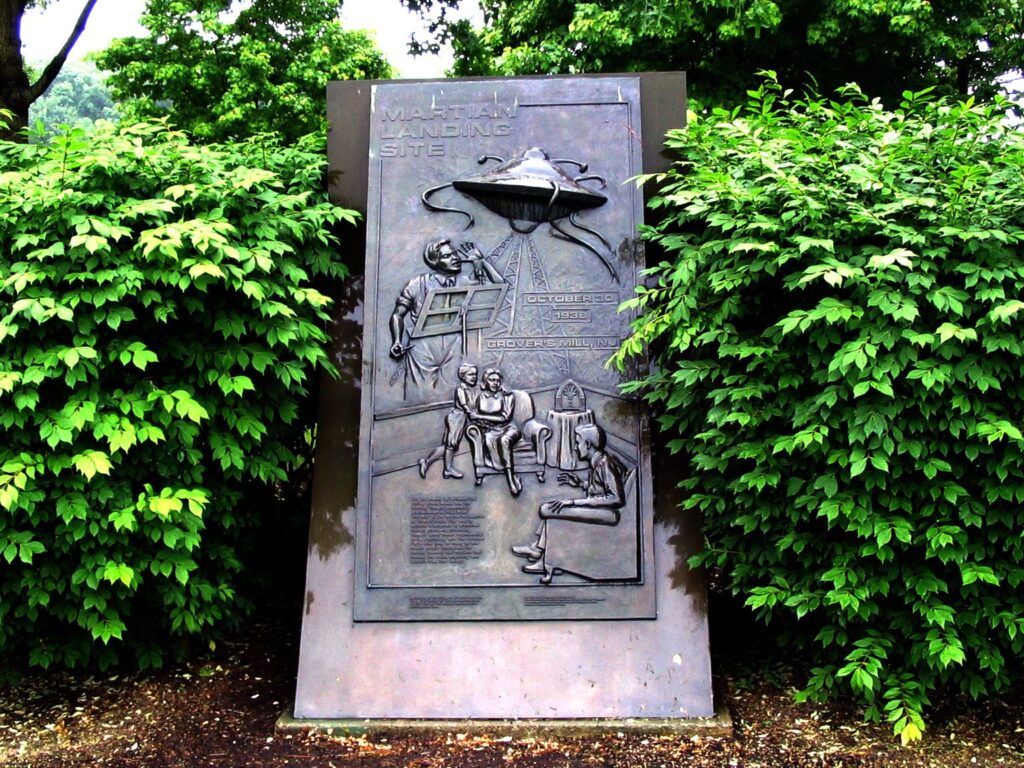
The War of the Worlds monument at Van Nest Park in Grovers Mill, New Jersey, commemorates the fictional Martian landing made famous by the 1938 radio broadcast. Public-domain photograph.
On the night of October 30, 1938, Grovers Mill, New Jersey, was a quiet rural community. Most Americans had probably never heard of it.
That was about to change.
In the broadcast, an announcer reported that a large object—initially thought to be a meteorite—had crashed into a field near Grovers Mill.
Soon, a fictional reporter named Carl Phillips was supposedly broadcasting live from the scene.
A crowd gathered around the strange object. Police arrived. Then the top of the cylinder began to move.
What emerged wasn’t a meteorite at all.
It was a machine from Mars.
The reporter described a creature emerging from the cylinder, followed by something even more terrifying: a heat ray. Police officers, spectators, and reporters suddenly seemed to be under attack.
Then the transmission from Grovers Mill went dead.
For listeners who understood they were hearing a radio drama, it was terrific theater.
For someone who had tuned in late, it could sound like something else entirely.
The Real Grovers Mill Wasn't Under Attack
While Martians were supposedly destroying the countryside over the radio, the real Grovers Mill remained perfectly safe.
Still, the broadcast did cause genuine confusion in parts of New Jersey.
Police departments received calls from worried listeners. Some people contacted newspapers or radio stations looking for confirmation. In the Princeton area, authorities even responded to reports connected with the supposed invasion.
Grovers Mill itself soon became the unlikely center of attention.
One of the most enduring local stories involves a water tower that some frightened residents supposedly mistook for a Martian war machine. The tale has been repeated for decades, although the details vary and are difficult to document with certainty.
That distinction matters.
There really were frightened people in New Jersey that night. Yet every colorful story repeated afterward shouldn’t automatically be treated as established fact.
What we can say with certainty is much simpler.
Before October 30, 1938, Grovers Mill was an obscure New Jersey community.
Afterward, its name belonged to American popular culture.
The Martians never landed in Grovers Mill.
The legend certainly did.
Did America Really Panic Over the War of the Worlds Broadcast?

Some People Really Were Frightened
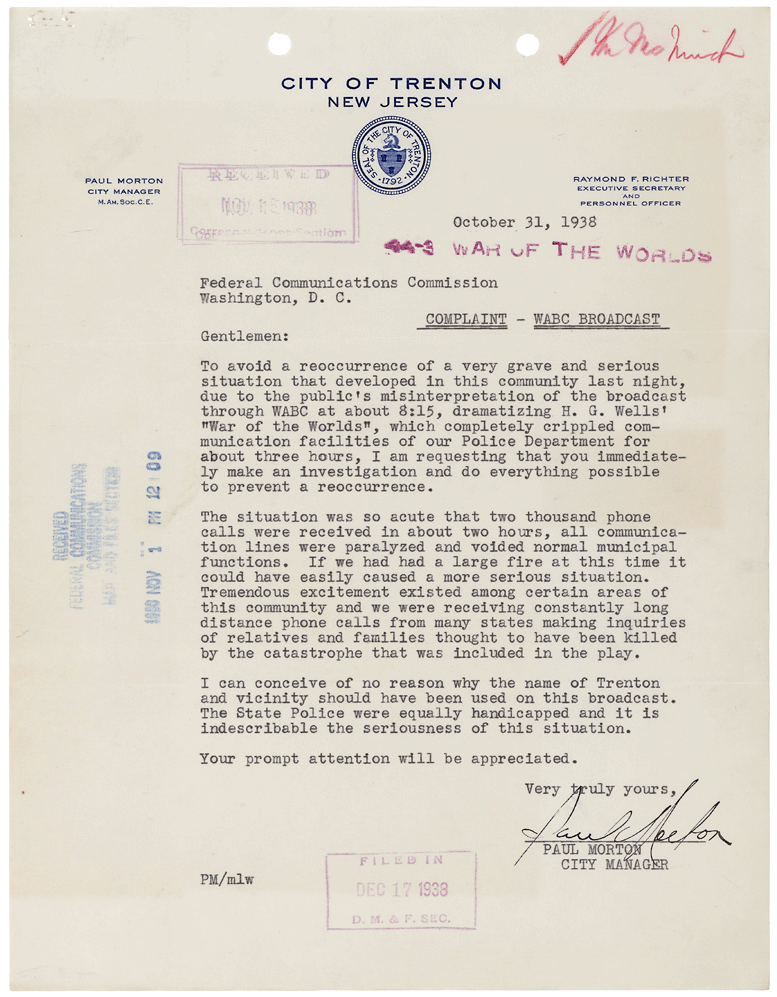
On October 31, 1938, Trenton city manager Paul Morton wrote to the FCC describing serious disruption to police communications following the broadcast. — National Archives
The stories didn’t come entirely from nowhere.
Some listeners genuinely believed that something terrible was happening on the night of October 30, 1938. Police departments, newspapers, and radio stations received calls from people trying to find out whether the reports were real.
In Trenton, New Jersey, city officials reported that police communications were overwhelmed by calls connected to the broadcast. Elsewhere, frightened listeners contacted authorities, relatives, and neighbors.
So it would be just as misleading to say nobody panicked as it would be to say America panicked.
Something happened that night.
The real question is how large it was.
And that’s where the familiar story begins to fall apart.
Most Americans Didn't Even Listen
A telephone survey conducted that night reached roughly 5,000 households and found that only about 2 percent of those surveyed were listening to The Mercury Theatre on the Air. Far more Americans had their radios tuned elsewhere.
And there was a formidable reason.
On NBC, ventriloquist Edgar Bergen and Charlie McCarthy were starring in the enormously popular Chase and Sanborn Hour. Welles and the Mercury Theatre were competing against one of the biggest programs on American radio.
That doesn’t mean the War of the Worlds audience was insignificant. Nor does it mean frightened listeners didn’t exist.
It does mean that later claims suggesting enormous portions of the country were simultaneously listening—and panicking—deserve a closer look.
So Where Did the Millions Come From?
One influential answer appeared two years later.
In 1940, Princeton psychologist Hadley Cantril published The Invasion from Mars: A Study in the Psychology of Panic. His study estimated that roughly 6 million people heard the broadcast and that about 1.2 million were frightened or disturbed by it.
Those numbers became enormously influential.
They also became controversial.
Cantril’s conclusions drew partly on detailed interviews with a relatively small group of listeners, including people already known to have been frightened by the program. Later researchers have questioned whether those interviews and other evidence could reliably support estimates involving millions of Americans.
In other words, the famous panic story wasn’t invented from nothing.
But over time, real incidents of fear, dramatic newspaper coverage, and disputed estimates blended together into something much larger than the evidence can comfortably support.
Some Americans were frightened. America itself did not descend into nationwide panic.
The stories didn’t come entirely from nowhere.
Some listeners genuinely believed that something terrible was happening on the night of October 30, 1938. Police departments, newspapers, and radio stations received calls from people trying to find out whether the reports were real.
In Trenton, New Jersey, the reaction became serious enough to interfere with police communications. City Manager Paul Morton wrote to the Federal Communications Commission two days later that the situation had become “very grave and serious.” He reported that police telephone lines were tied up by calls from frightened residents.
So it would be just as misleading to say nobody panicked as it would be to say America panicked.
Something happened that night.
The real question is how large it was.
And that’s where the familiar story begins to fall apart.
Most Americans Weren't Even Listening
Here is where the legend runs into a stubborn problem.
Most Americans weren’t listening to the broadcast.
A telephone survey conducted that evening reached roughly 5,000 households. According to the Library of Congress, only about 2 percent of the people contacted said they were listening to The Mercury Theatre on the Air.
Most radio listeners were somewhere else on the dial.
One reason was formidable competition. Over on NBC, Edgar Bergen and Charlie McCarthy were appearing on the enormously popular Chase and Sanborn Hour. For many families, that was their Sunday-night entertainment.
Oddly enough, that competition may also help explain why some people were fooled. A listener who switched stations after Welles’ opening announcement could arrive after the program had already identified itself as a dramatization.
Instead of hearing the introduction, that listener might encounter urgent bulletins about explosions on Mars, a strange object in New Jersey, and a reporter apparently describing the scene live.
That doesn’t mean the War of the Worlds audience was insignificant. Nor does it mean frightened listeners didn’t exist.
It does mean something important:
A story about virtually an entire nation being thrown into panic becomes difficult to reconcile with evidence showing that most of the nation wasn’t listening in the first place.
The Panic Was Real—But the Legend Was Bigger
Some Americans were genuinely frightened on October 30, 1938. The letters, telephone calls, and reports from places such as Trenton leave little doubt about that.
At the same time, the evidence doesn’t support the familiar picture of an entire nation running for cover from Martians.
Most Americans weren’t listening. Many who were listening understood that they were hearing a radio drama. And some listeners, like J. V. Yaukey in South Dakota, simply sat back and enjoyed the show.
What happened that night was remarkable enough without embellishment.
The larger story came afterward.
As reports of frightened listeners spread, newspapers across the country began telling Americans what had supposedly happened the night before. Dramatic incidents made dramatic headlines—and those headlines would help shape how generations remembered October 30, 1938.
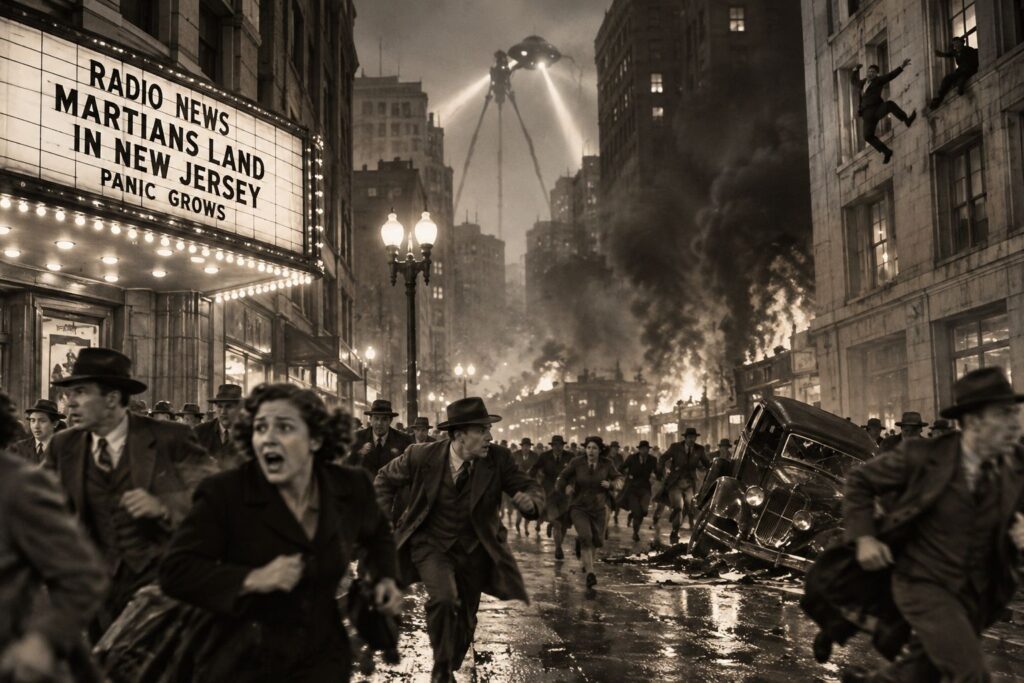
Nostalgia Nook Antiques Note: The fear was real. The nationwide panic became the legend.
What the Newspapers Said the Next Morning
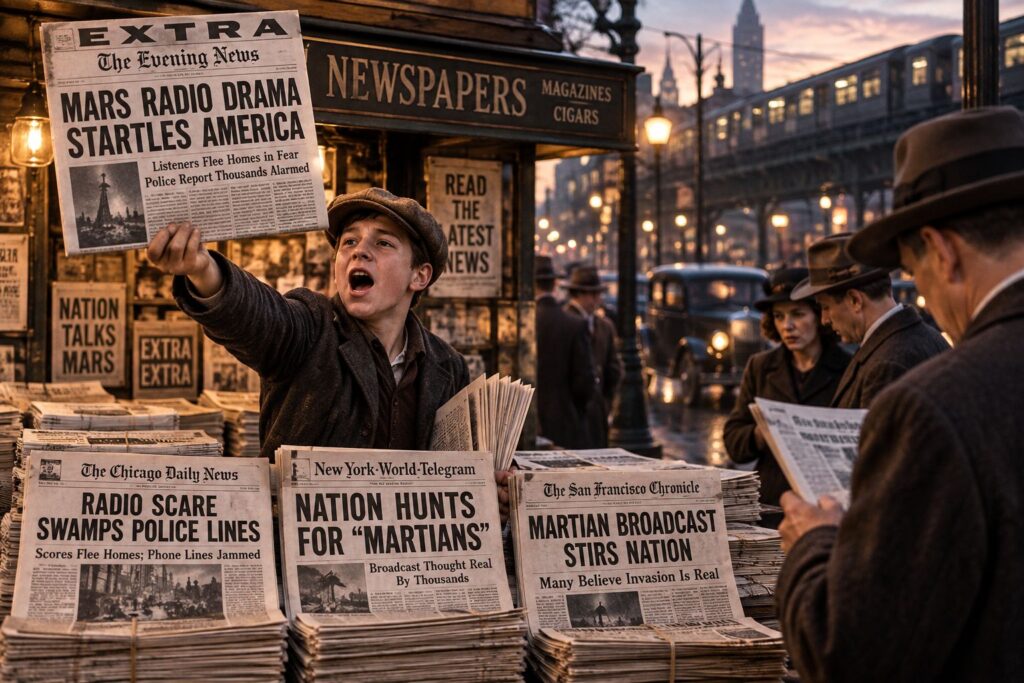
The morning-after legend: an illustration inspired by the sensational newspaper coverage that followed the 1938 War of the Worlds broadcast.
The radio drama had ended.
The story of the panic was only beginning.
By Monday morning, October 31, newspapers across the country were reporting on frightened listeners, jammed telephone lines, calls to police stations, and people who had mistaken Orson Welles’ fictional invasion for the real thing.
The headlines were irresistible.
The New York Times told readers of “Radio Listeners in Panic, Taking War Drama as Fact.” Other newspapers used similarly dramatic language to describe what had happened the night before.
There was truth behind some of those stories. As we’ve already seen, frightened listeners really did telephone police and radio stations. Trenton experienced genuine disruption. The FCC received letters from both angry listeners and people who thought the program was brilliant.
Yet something important was happening at the same time.
Scattered incidents of genuine fear were becoming a national story about mass panic.
A Better Story Than the Evidence
News reports naturally focused on the most dramatic incidents.
A listener who calmly recognized the Mercury Theatre drama wasn’t much of a newspaper story. Neither was someone like J. V. Yaukey, who simply sat at home and enjoyed the program.
A frightened family rushing outside?
That was different.
A police switchboard overwhelmed with telephone calls?
Even better.
A report that people believed Martians were attacking New Jersey?
That practically wrote its own headline.
As those stories appeared from city to city, they created an impression far larger than any single incident.
Before long, Americans weren’t merely hearing that some listeners had been fooled.
They were hearing that America had panicked.
Radio Was Changing the News Business
There was another wrinkle to the story.
By 1938, radio wasn’t simply entertainment. It was becoming one of the fastest ways Americans could learn what was happening beyond their hometowns.
That put newspapers in an uncomfortable position.
For generations, the morning paper had been one of America’s primary sources of news. Radio could now interrupt an evening program and bring a developing story into the living room almost immediately.
The two industries were competing for something extremely valuable:
attention.
Against that backdrop, the War of the Worlds broadcast handed newspapers an extraordinary story. Here was radio—the exciting new medium—appearing to demonstrate just how dangerous and irresponsible it could be.
Later media historians have argued that this rivalry helped shape the coverage that followed. In their view, newspapers had good reason to emphasize radio’s role in frightening the public.
We can’t know that every editor or reporter had the same motive.
Still, the irony is hard to miss.
Radio created the scare. Newspapers helped create the legend.
Nostalgia Nook Antiques Note: A frightening radio broadcast lasted about an hour. The story told about it has lasted for generations.
Own a Piece of the Headlines
Original newspapers let us see history the way Americans first encountered it—one headline at a time. Issues from 1938 and other major moments in American history can still be found by collectors today.
From Martians to AI: Are We Panicking Again?
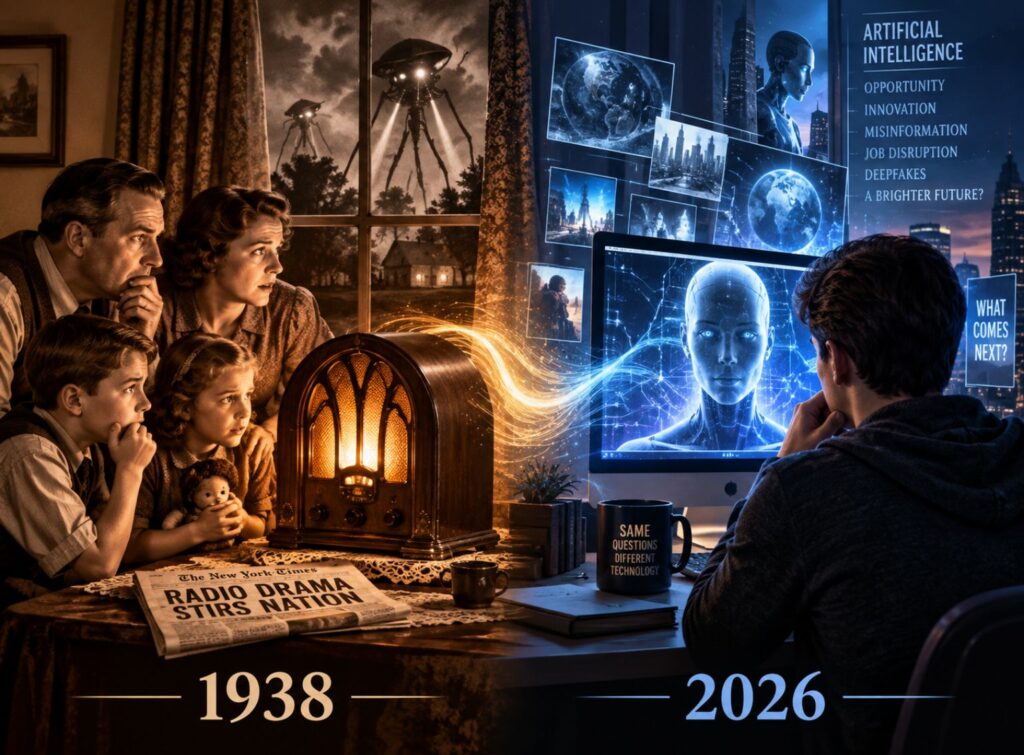
In 1938, the frightening new technology wasn’t a Martian heat ray.
It was radio.
For the first time, a voice hundreds of miles away could enter the family living room and describe events almost as they happened. Radio brought presidents, ballgames, music, breaking news, and reports from a troubled Europe directly into American homes.
Then, for one remarkable hour, that same technology made an invasion from Mars sound real to some listeners.
Nearly nine decades later, we’re living through another technological upheaval.
This time, it’s artificial intelligence.
AI can write stories, create photographs, imitate voices, generate video, answer questions, and perform tasks that only a few years ago seemed safely confined to science fiction.
And once again, some of the predictions are frightening.
Jobs will disappear. Nobody will know what’s real. Machines will become smarter than humans. Artificial intelligence will eventually take control—or, in the darkest predictions, threaten humanity itself.
Some concerns surrounding AI are legitimate and deserve serious attention. Fraud, convincing deepfakes, employment disruption, privacy, misinformation, and the concentration of technological power aren’t imaginary problems.
But neither were the frightened telephone calls on October 30, 1938.
The lesson of The War of the Worlds isn’t that fear is foolish.
It’s that fear can grow faster than the evidence.
We Have Seen This Movie Before
In 1938, a relatively small number of genuinely frightened listeners became, in popular memory, an entire nation running from Martians.
Today, something similar can happen at breathtaking speed.
A disturbing AI demonstration becomes a headline. The headline becomes a social media post. The most alarming prediction gets repeated, discussed, shared, and repeated again.
Before long, a possibility can begin to feel like an inevitability.
That doesn’t mean the possibility should be ignored.
It means we should remember the difference.
What could happen is not necessarily what will happen.
That distinction was easy to lose when fictional Martians were marching across New Jersey.
It may be even more important in the age of artificial intelligence.
Before We Decide the Martians Have Landed
I know how convincing fear can be when you’re missing a little context.
I learned that sometime in 1969, lying alone in the dark and listening to Martians invade a world that wasn’t actually under attack.
More than half a century later, the technology has changed. The questions surrounding artificial intelligence are real, complicated, and worth taking seriously.
Still, October 30, 1938, leaves us with a useful reminder.
Listen carefully. Ask questions. Separate what has actually happened from what someone says might happen.
New technology has always brought possibilities we couldn’t fully predict. Some turned out better than expected. Others created problems nobody anticipated.
AI will undoubtedly bring surprises of its own.
But before we decide the Martians have landed, perhaps it’s worth looking out the window.
Keep Exploring the Story
What Vintage Technology Still Works Today?
From rotary phones and record players to other inventions that refused to disappear, discover which technologies from the past still have a place in modern life.
The Music That Kept America Dancing:
From radio and jukeboxes to the songs Americans gathered around, revisit the music and technology that helped provide the soundtrack to everyday life.
America’s Vintage Living Rooms: Where Families Belonged
Come back inside, where the radio played, families gathered, and an ordinary evening at home could become a favorite memory.
Vintage Jukebox History: America’s Original Social Playlist
Before streaming and digital playlists, jukeboxes turned music into a shared experience and became another technology that changed how Americans heard their favorite sounds.
Why America Loved Drive-In Theaters: The Summer Nights We Never Forgot
Another new technology transformed American entertainment—this time putting movies on giant outdoor screens and creating memories that lasted long after the final credits.
The technology changes. The stories we tell about it have a way of sticking around.